
| CA Foundation Classes |
CA Inter Classes |
CA Final Classes | StudyByTech Offers | Contact us |
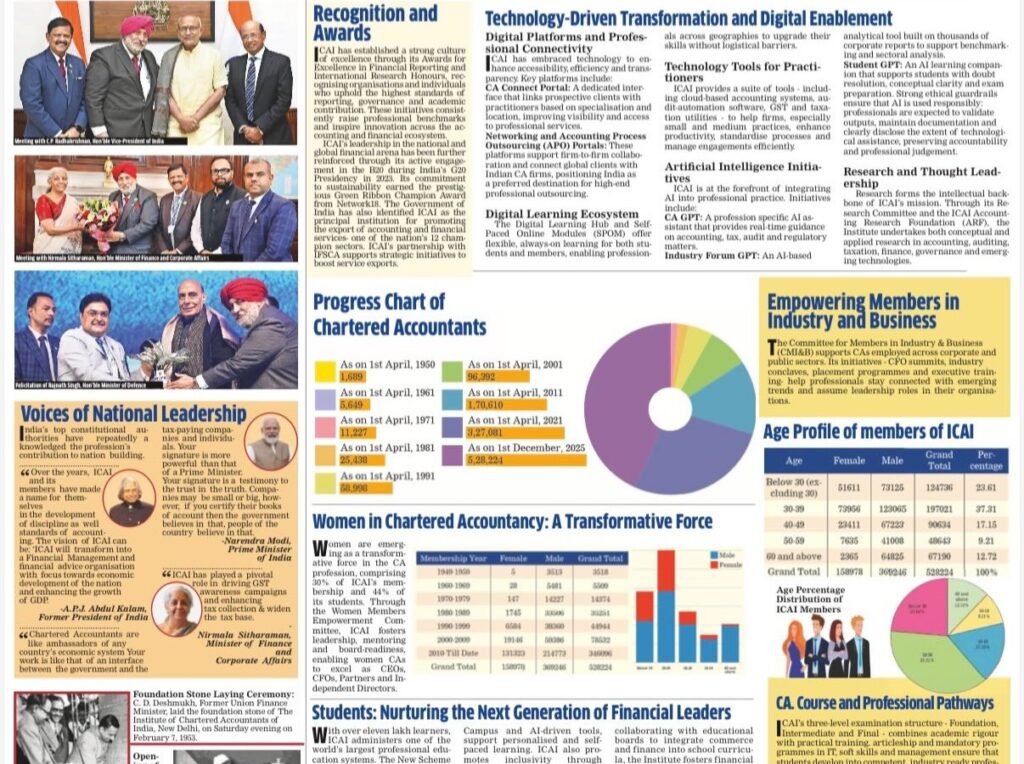
The landscape of chartered accountancy has drastically changed, according to official statistics. As per The Economic Times dated 19th December, 2025, in less than five years, CAs have grown from 3,27,081 (1 April 2021) to 5,28,224 (1 December 2025), adding over two lakh members. This surge has huge implications for CA students, young chartered accountants, firms, and the long‑term brand value of the Institute of Chartered Accountants of India qualification.
The New CA Economy: Security Or Illusion?
For decades, “CA” was almost synonymous with financial security and professional respect. That presumption is no longer assured today.
- Even though the number of young CAs is skyrocketing, entry-level salaries in many metro areas are stagnating.
- Tax laws are becoming more straightforward, and compliance work is becoming volume-driven and standardized.
- Routine tasks like GST returns, TDS filings, reconciliations, basic audits, and MIS reporting are quickly being replaced by automation and AI tools.
Short-term job scarcity is not the only real risk. If the increase in membership is not accompanied by an equivalent improvement in skills, capabilities, and work quality, the deeper concern is a gradual dilution of the CA brand.
Key question: Are we creating strategic finance experts or merely inexpensive, easily replaceable compliance executors in an era of automated compliance and tax simplification?
Law → SPOM: Are We Weakening Our Legal Edge?
Strong exposure to corporate law, insolvency, and regulatory frameworks has historically been one of Indian CAs’ main advantages. Many CAs were able to appear as counsel before RD, NCLT, and NCLAT thanks to this foundation, and they were able to play significant roles in boardroom decision-making, restructuring, and litigation support.
By pushing Law in a SPOM basket that is simpler to clear:
- Exam incentives to develop in-depth knowledge of corporate and bankruptcy law decline.
- When a paper is viewed as “safe,” students instinctively put clearing it ahead of conceptual mastery.
- Future generations of CAs might eventually lack the legal expertise that made previous generations of CAs popular in high-stakes negotiations and tribunals.
If the current trend keeps up, should Chartered Accountants still have an automatic right to appear as counsel in complex matters before the MCA and tribunals? Lose that standing and the profession doesn’t just wobble — it takes a long-term hit.
Costing → SPOM: Who Will Own Strategic Cost & Performance?
Cost and Management Accounting and Strategic Cost Management & Performance Evaluation are not “optional scoring subjects”; they are the backbone of business decision‑making—pricing, profitability analysis, performance dashboards, cost leadership, and strategic planning.
Cost and Management Accounting, and Strategic Cost Management & Performance Evaluation, are not optional extras. They are the backbone of business decision-making — pricing, profitability analysis, performance dashboards, cost leadership and long-range strategy. You see their fingerprints everywhere: in boardroom debates, in late-night spreadsheet revisions, in the one slide that can change the CEO’s mind.
By shifting Costing/SCMPE into SPOM and making it very easy to clear:
- Genuine mastery in strategic cost and performance management takes a back seat.
- Many students treat it like a box to tick rather than a serious skill that can differentiate them in the job market.
The result is a gap. Others are already moving into that space:
- CMA India positions itself as the specialist in cost and management accounting.
- ACCA globally markets strong exposure to performance management, financial management, and analytics — and in many corporate roles ACCA pay packets already rival those of CAs.
If CAs stop being the obvious choice for strategic costing, performance management and decision support, CMAs and ACCAs will increasingly own that territory here and overseas.
AI, Compliance And The Future Of CA Jobs
Technology is pushing the profession in one direction:
- Routine compliance is becoming click-based and increasingly automated.
- Data extraction, confirmations, vouching, trend-spotting and even chunks of risk-based sampling can be handled by AI and advanced tools.
- Clients will only pay premium fees for insights, strategy and high-value advisory — not for basic filings that a script can do.
Now imagine adding lakhs of new members while:
- entry‑level salaries stay flat,
- traditional audit and tax practice gets overcrowded, and
- routine work becomes low‑margin and automated,
The “CA” label alone won’t guarantee the lifestyle or career trajectory many students expect. The sustainable defence is upskilling — analytics, strategic finance, business partnering, and technology‑driven value creation. In short: move from doing to advising. That’s where the fees, and the interesting work, will be.
“10L+ CA Students”: Headline vs Reality
We often hear that there are more than 10 lakh CA students. But CA registration remains valid for 5 years:
- Thousands who’ve quit or mentally moved on are still counted as “registered students”.
- The number of active, exam‑appearing, seriously pursuing students is much lower.
- Compare registrations with exam forms, pass-outs and repeaters and you’ll spot a sizeable cohort that has quietly disappeared.
So here’s a blunt question: Are we running the ecosystem for real learning and outcomes—or are we chasing headline numbers?
Where ICAI Actually Deserves Credit
Despite these concerns, the growth in membership is not inherently bad. There are clear upsides:
- More pass-outs and earlier qualifiers are choosing ICAI membership rather than drifting away.
- This has created:
- A larger and more connected CA network across India and abroad.
- Stronger bargaining power in policy discussions, international MoUs and global standard‑setting.
- Higher membership revenue can be reinvested into member services, technology platforms, global visibility and learning.
The key issue is how this boom is used. Numbers alone cannot protect the profession; it’s what we do with them that counts.
What Should The Profession Do With This Boom?
To convert the membership explosion into a genuine long‑term advantage, three things are urgent:
- Restore rigour in Law and Costing/SCM/SPM
- Invest membership revenue in new‑age skills and career pathways
- Position CAs alongside Tier‑1 MBAs, not just merely as peers to other accounting bodies
Who Is Writing This?
This analysis comes from daily experience with CA students who struggle to make sense of the changing landscape.
I am CA. Parag Gupta, teaching Cost and Management Accounting at CA Intermediate and Strategic Cost and Performance Management at CA Final. I have served as a CA Final examiner (paper checker) and actively promoted fair examination practices as an ICAI observer. I am a highly sought-after mentor, particularly by top achievers, due to my mastery of subjects like Cost & Management Accounting, Strategic Management, Strategic Cost and Performance Management, Integrated Business Solutions (IBS), and Operations Research.
Students and firms looking for structured guidance can explore more detailed resources and courses at: 👉 paraggupta.com and 👉 studybytech.com
A Question For Every CA, Student And Employer
- Will the next decade belong to future‑ready CAs who understand analytics, strategy and technology—or to those who are satisfied with basic filings and statutory checklists?
- Are we, as a community, comfortable celebrating only the increase in numbers—or are we willing to ask tougher questions about curriculum, training, and long‑term positioning of the CA brand?
This isn’t an attack on the Institute. It is a call for course‑correction and honest introspection.
If you are a CA, CA student, commerce student, HR head or finance leader, share your views. Would you still recommend CA to a bright Class‑12 student with the same confidence you had ten years ago? Or would you now add caveats — and a stronger push toward new-age skills?
Your honest feedback will shape how seriously the ecosystem responds to these challenges.