How to Master Both Groups with the Best CA Inter Classes: Full Preparation Guide
The Chartered Accountancy (CA) path is one of the most respected and satisfying career options in finance and business. Positioned between the Foundation exam and the ultimate CA Final stage, the CA Intermediate level is widely regarded as the most decisive milestone. It tests far more than your memory—it evaluates your analytical power, conceptual clarity, and resilience.
🔑 Key Questions Every Aspirant Faces:
This comprehensive guide addresses every single aspect—from understanding the exam framework to building a winning learning timetable.
1. Knowing the CA Intermediate Exam Setup
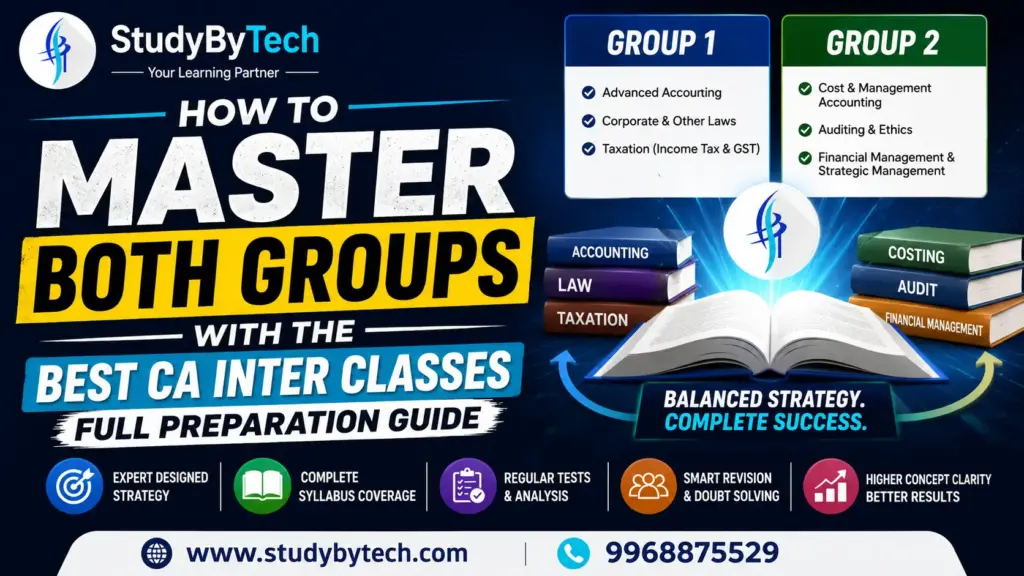
To succeed in the CA Intermediate exam, you must first understand the curriculum layout. Formulated under ICAI guidelines, the program is divided into two groups, comprising six critical papers:
📘 GROUP 1
- Paper 1: Advanced Accounting
- Paper 2: Corporate and Other Laws
- Paper 3: Taxation (Direct Tax & Indirect Tax)
📙 GROUP 2
- Paper 4: Cost and Management Accounting
- Paper 5: Auditing and Ethics
- Paper 6: Financial Management & Strategic Management (FM & SM)
⚡ Both Groups vs. Single Group Strategy: Preparing for both groups together allows you to leverage the “Set-Off” rule (where surplus marks in one group offset a shortfall in another) and saves considerable time in your overall CA timeline. However, it demands high discipline and 8 to 12 hours of dedicated study daily.
2. Coaching vs. Self-Study: Making the Right Choice
Choosing between taking coaching classes or studying independently depends on your learning style, budget, and personal self-discipline.
✅ Benefits of Coaching
- Expert Guidance: Complex subjects like Costing, Tax, and Law are simplified by experienced faculties.
- Structured Learning & Doubt Resolution: Regular interaction allows fast clearing of doubts and peer learning.
- Routine Mock Tests: Continuous evaluation provides constructive feedback on exam readiness.
✅ Benefits of Self-Study
- Full Schedule Control: Learn at your own comfortable pace without rigid class timings.
- Highly Cost-Effective: Eliminates high tuition fees and daily commute expenses.
- Tailored Focus: Allocate extra time to weak subjects while speeding through familiar topics.
- Builds Problem-Solving Skills: Fosters independence, an indispensable skill for your future career.
🚀 The Optimal Strategy: A Hybrid Approach
Top scorers rarely rely on just one mode. They enroll in coaching for core conceptual clarity and tough practical problems, while dedicating equal personal study hours to revise, solve exercises, and build original notes.
3. Online Classes vs. Offline Classes
With modern technological advancements, CA students are no longer required to relocate to major hubs for quality education.
| Feature | 💻 Online Classes | 🏫 Offline Classes |
|---|---|---|
| Flexibility | High. Watch live or recorded sessions anytime. | Low. Fixed batch timings and physical presence required. |
| Learning Pace | Self-paced. Rewind, pause, or rewatch complex topics. | Set by class speed; fixed pace for all students. |
| Cost & Travel | Economical. No travel, lodging, or commuting costs. | Higher expenses including commute & accommodation. |
| Interaction | Live chats, discussion forums, scheduled Q&A. | Direct, face-to-face real-time interaction. |
| Self-Discipline | High. Requires internal drive to stay on schedule. | Medium. Peer presence helps maintain routine. |
💡 Which should you choose? If you thrive in a competitive classroom setting, in-person classes may suit you. However, if you prefer learning from India’s top educators from home without commuting fatigue, online classes offer superior efficiency.
4. 7 Key Factors When Selecting Coaching
Selecting the right institute or mentor significantly influences your preparation quality. Consider these seven critical aspects:
5. Step-by-Step Preparation Plan (Both Groups)
Clearing CA Intermediate requires structured execution over an 8-to-10-month timeline.
Syllabus Completion & Concepts: Focus on core understanding, attending classes, and daily practice.
First Full Revision: Systematic topic reviews and preliminary subject-wise mock tests.
ICAI Papers & Practice: Solve Revision Test Papers (RTPs), Mock Test Papers (MTPs), and past papers.
Final Touch-Up: Fast-track revision using summary notes, formula sheets, and key standards.
🌟 Golden Rules for Execution:
💭 Final Thoughts
Passing CA Intermediate on your first attempt is not a matter of luck—it is the result of strategic planning, conceptual clarity, and unrelenting execution. Focus on deep understanding, practice regularly under exam conditions, and stay true to your revision roadmap. Start early, trust your strategy, and work consistently toward your goal!
❓ FAQ
Which online class is best for CA Inter?
Parag Gupta classes are best for CA Inter
Is 2.5 months enough for CA Inter?
Yes, if you have completed the course already then revising the full CA Inter course in 2.5 months is possible. But you need to do work instead of procrastinate. Create a doable time table and give emphasis to 2 subjects on 1 day. Parag Gupta sir (one of the most recommended faculty for CA Inter Costing) provides proper time table to revise and practice concepts of CA Inter Costing within 15 days.
Can I self-study for CA Inter?
Yes, if you are diligent and well-organized, self-study can be a practical and economical strategy. Through careful preparation and commitment, self-study can help you achieve success in the CA Intermediate exams.
How many hours to study for CA Inter?
The amount of time you need to study for the CA intermediate examinations will depend on when you begin, but on average, you should dedicate 8 to 12 hours a day, or more, to succeed.
Leave a Comment — You must be logged in to post a comment.
Shopping Cart
Want to join classes from Parag Gupta sir?