
| CA Foundation Classes |
ICAI Registration Process |
Subjects, Syllabus & Exam Pattern |
Admit Card |
Exam Dates |
Exam Tips |
About the faculties |
FAQ’s |
If you are planning to start your Chartered Accountancy journey, understanding the CA Foundation syllabus is the first and most important step. Many students begin preparation without knowing the exact subjects, chapter weightage, exam pattern, or the changes introduced under the latest ICAI scheme. Because of this, they often waste time studying less important topics while missing scoring areas.
In this updated guide, we will cover the complete CA Foundation Syllabus & Subjects 2026, including paper-wise topics, exam pattern, marking scheme, preparation tips, and important updates every student should know before starting preparation.
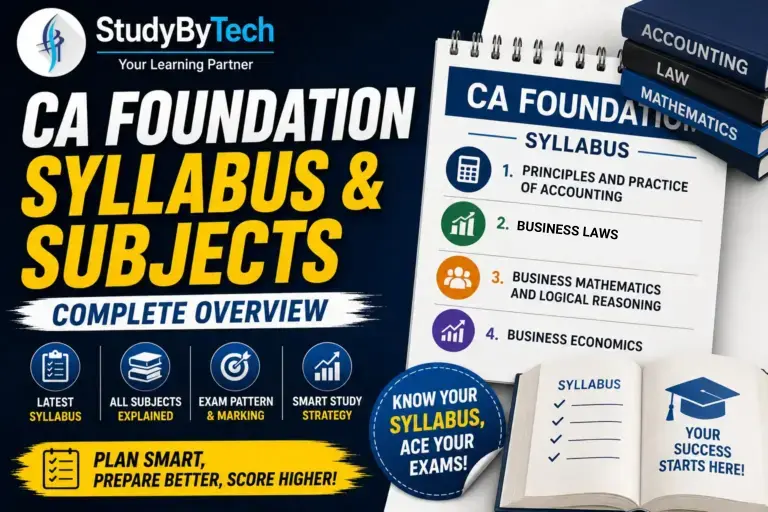
According to the latest ICAI structure, the CA Foundation course now consists of 4 papers covering Accounting, Law, Quantitative Aptitude, and Economics.
CA Foundation Course Overview
The CA Foundation exam is conducted by the Institute of Chartered Accountants of India and acts as the entry-level examination for students who want to become Chartered Accountants.
Students can register after Class 10, but they become eligible to appear for the exam only after passing Class 12.
CA Foundation Subjects 2026
The latest CA Foundation syllabus contains 4 papers:
| Paper | Subject | Marks | Type |
| Paper 1 | Accounting | 100 | Subjective |
| Paper 2 | Business Laws | 100 | Subjective |
| Paper 3 | Quantitative Aptitude | 100 | Objective |
| Paper 4 | Business Economics | 100 | Objective |
The syllabus focuses more on conceptual clarity and practical understanding rather than rote learning.
Paper 1 – Accounting Syllabus
Accounting is considered one of the most important scoring subjects in CA Foundation. It builds the base for CA Intermediate and future professional studies.
Important Topics in Accounting
- Theoretical Framework of Accounting
- Accounting Process
- Bank Reconciliation Statement
- Inventories
- Depreciation and Amortisation
- Bills of Exchange
- Final Accounts
- Accounts from Incomplete Records
- Partnership Accounts
- Company Accounts
- Non-Profit Organisation Accounts
Students who practice regularly usually score very well in this paper because most questions are concept and format based.
Paper 2 – Business Laws Syllabus
Business Law is a theory subject, but it becomes easy when students understand concepts instead of memorising everything blindly.
Important Topics in Business Laws
- Indian Contract Act
- Sale of Goods Act
- Partnership Act
- LLP Act
- Companies Act
- Negotiable Instruments Act
- Indian Regulatory Framework
One common mistake students make is ignoring writing practice. In Law, presentation and keywords matter a lot.
Paper 3 – Quantitative Aptitude Syllabus
This paper is divided into three parts:
| Part | Topic | Marks |
| Part A | Business Mathematics | 40 |
| Part B | Logical Reasoning | 20 |
| Part C | Statistics | 40 |
Important Mathematics Topics
Ratio & Proportion Equations Linear Inequalities Time Value of Money Permutation & Combination Sequence & Series Basic Calculus
Important Logical Reasoning Topics
Seating Arrangement Coding-Decoding Blood Relations Direction Test
Important Topics in Statistics Topics
- Measures of Central Tendency
- Probability
- Correlation & Regression
- Index Numbers
Students usually find this subject difficult initially, but daily practice improves speed and accuracy significantly.
Paper 4 – Business Economics Syllabus
Economics helps students understand business environments and market behaviour.
Important Topics in Economics Topics
- Nature & Scope of Economics
- Theory of Demand & Supply
- Production & Cost
- Market Structures
- National Income
- Money Market
- Public Finance
- International Trade
- Indian Economy
Economics is considered one of the highest-scoring papers if concepts are clear and revision is done properly.
CA Foundation Exam Pattern 2026
Before starting preparation, students should understand the latest exam pattern.
Key Highlights
- Total Papers: 4
- Total Marks: 400
- Passing Requirement:
- Minimum 40% in each paper
- Minimum 50% aggregate overall
- Objective papers have negative marking
- Subjective papers require descriptive answers
The updated scheme focuses more on conceptual understanding and analytical skills.
Important Changes in CA Foundation Syllabus
Under the new scheme:
- The total number of subjects has reduced from 6 to 4.
- Business Correspondence & Reporting has been removed.
- Business & Commercial Knowledge has also been removed from the Foundation level.
This change has made the syllabus more focused and manageable for students.
Best Preparation Strategy for CA Foundation
- Focus on Concept Clarity: Do not rely only on mugging up theory. CA exams are designed to test understanding.
- Make a Proper Study Plan: Allocate separate time slots for practical and theory subjects.
- Solve ICAI Questions: ICAI questions help students understand the actual exam level.
- Practice Mock Tests: Mock tests improve speed, confidence, and presentation.
- Revise Multiple Times: Revision is the real key to scoring high in CA Foundation.
Common Mistakes Students Make
- Ignoring revision
- Studying without a timetable
- Avoiding practical questions
- Memorising Law without understanding concepts
- Not solving RTPs and MTPs
- Depending only on one-shot videos
Many students on Reddit also mention that self-practice and consistency matter more than just watching lectures.
How Much Time is Required for CA Foundation Preparation?
For most students, 6–8 months of serious preparation is enough if studies are consistent. Students who study daily with proper revision and mock tests generally perform much better than those who study irregularly for long hours.
Is CA Foundation Difficult?
CA Foundation is not impossible, but it definitely requires discipline and consistency. Students often feel overwhelmed because they try to complete everything quickly instead of building concepts step-by-step. With the right strategy, regular practice, and smart revision, clearing CA Foundation in the first attempt becomes achievable.
Final Words
The CA Foundation syllabus is designed to build a strong base for your Chartered Accountancy journey. Instead of getting scared by the syllabus size, focus on completing topics gradually with consistency.
Remember, students who succeed in CA Foundation are usually not the ones studying 15 hours daily. They are the ones who revise regularly, practice questions properly, and stay disciplined throughout preparation.
If you start early and follow a structured study plan, scoring well in CA Foundation becomes much easier.
FAQ’s
The CA Foundation 2026 exam comprises four essential papers: Principles and Practice of Accounting, Business Laws, Business Mathematics and Logical Reasoning & Statistics, and Business Economics.
Yes, the CA Foundation exam can be challenging for many candidates. due to the vast syllabus and multiple subjects
One great thing about this career is that you don’t need to study math in 12th grade to pursue it. Math isn’t essential for Chartered Accountancy, making it a great option for commerce students who didn’t take math. To become a Chartered Accountant, you must pass a three-tier exam.
The CA Foundation includes subjects such as Accounting, Business Laws, Mathematics, Economics, and more, offering a foundational understanding crucial for aspiring chartered accountants.